Uncle Bob has this punchline: “Software” is a compound word = “soft” (changeable) + “ware” (product).
“If it’s hard to change, you have just reinvented Hardware.”
Uncle Bob means soft as a virtue, the kind you earn. Code stays changeable because someone had the discipline to keep it that way. Which is where my train of thought started, because with swarms and hordes of Coding Agents we have arrived at the softest software has ever been. And I’m not sure it’s the same soft.
The old soft was hard to build, easy to change. The new soft inverts it: soft to make, then hard overnight, not because it was architected well, but because nobody, its author included, can read it anymore. Wet clay that fires into a shape you can’t rework. If it’s hard to change, you’ve reinvented hardware. Now, in a single afternoon.
So softness didn’t increase. It moved, from the end of a product’s life to the start of it. And that’s where I started wondering what Kundera would say, because this new lightness is exactly the kind he was suspicious of.
Originally we were going fast to adapt to the market. The market changes all the time and requires you to find an edge. This is the reason more and more half baked “products” are presented to the public.
– “We have to try out the waters with a prototype”
You have heard it. I have heard it a million times. It should be lean, it should be fast and it should generate revenue on day 0.
This is how you start to peddle a notion of a product to consumers. Selling the idea of a product, or surprising them with the same AI generated webpage, as a treat. Calling them To the Action of giving you personal data.
So we have a need to move fast, it did not change, it was present and up close for a long time now. But now we have a velocity no generation could dream about. We have the technology to implement most of the ideas we have in a few days. We have low-code and no-code platforms with AI integrated which can be even faster. With the speed we have achieved the diversity to have personal apps for everybody. You have an idea? Tomorrow you can solve your own problems.
Your own apps are yours to keep, but yours to upkeep as well. Maintenance has achieved a new level of prestige, alongside with the brave souls who dare to take over older vibe-coded projects.
Back to the point, we have the capacity to create, the only bottleneck is the ideation and the sales. Now the main question is not if it has been build, but alas, if not, why didn’t it? Still creativity is not growing on the trees. The app stores see a never before boom. Sadly a boom of the same apps.
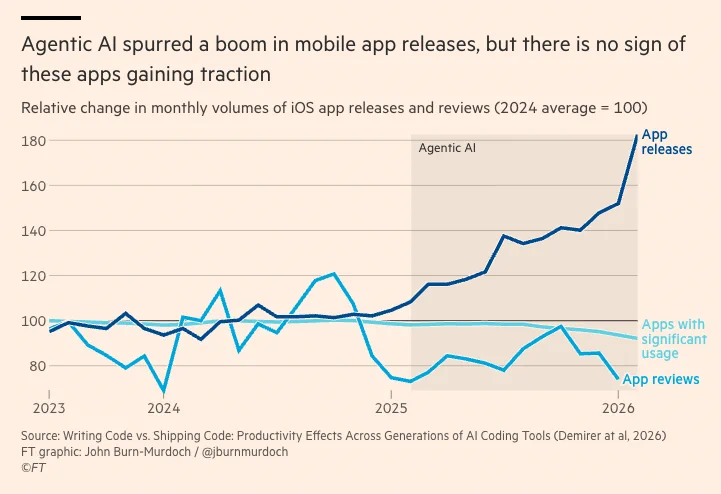
And what about the old reliable apps of the past? How do apps built before the agentic boom hold up?
Well, the new wave of pressure to create has not missed those in charge of them as well. Every brand felt the need to provide an AI feature, which could be hijacked to solve elementary programming questions. Which is somewhat done, but every user is pushed towards using it.
To drive adoption, users should be forced to try out the new features. They will love it. They will depend on the new and shiny way their now not so reliable product operates. Of course they will love it, similarly to the copilot and google search adoption rates.
And with the flops came the distinguishing factors, polish and taste. This is how polish has become a status symbol, see, even AI providers lean into their humane side. Still it is early to say if this craze will stick. Currently it is more of a shtick than a real movement. Leaning in and showing polish is mostly a game of the giants. For smaller companies and everymen we have the same kind of bulletins and the same emails.
When thinking about creation we should take a step back and think about it.
All that’s left is ideation. And that is the hardest part. Research has shown that AI has a homogenization effect. But it would be enough to think about how every AI tool got the sparkle and the purple gradient. So ideation, having a real new idea IS hard. Also there is a perceived pressure.
If everything can be built, and already should be, what’s worth building? Here Kundera comes back. His lightness was never only freedom. It was freedom that curdles into meaninglessness. What happens once, he says, might as well not have happened at all. Einmal ist keinmal. An app you ship in a day and forget by the next happens once. It’s light. It weighs nothing, it means nothing, and the app store fills with a hundred thousand of them.
So the lightness we cheered, the promise that anyone can build anything, is the same lightness that makes any one thing built not matter. That’s the unbearable part. Weightlessness looked like the reward and turned out to be the problem.
And it is a very convenient problem for the people doing the shipping. If nothing you make has to matter, nothing you make has to be good. That is the FOMO under most of the enshittification worldwide: weightlessness is the alibi. Bolt the AI feature on, force the adoption, let the market forget by Tuesday.
What still has weight is the one thing the agents can’t hand you: a real idea, taste, and the nerve to return to something instead of leaving it half-built. In Kundera weight is not the enemy, it is the point. So the old 2015 question is already dead. Should I buy or should I build? Building is free now, which makes it a reflex, not a decision. The only question left is whether you are making something worth the weight, or just one more thing that happened once, and might as well not have.