You might have heard that monkey see, monkey do. In reality monkey only does if they see the why. A not-so-recent experiment showed that overimitation in humans is quite prevalent. More on this in this article by the New York Times. In this research children were shown a complicated contraption and a long process on how to open it and get the treat. Similarly the same way done to monkeys. And the punchline of the experiment was the second part. The same contraption, but with see-through walls. Monkey see, monkey did not do, monkey went out and eat the treat, as the process was unnecessary to get it. Children on the other hand see and imitated the original process without questions.
I strongly believe thus that, doing things for the culture is the most human thing we can do. The referenced experiment shows exactly how myths shape our way of learning and working. We are conditioned to do things in the way the group decided on. Sometimes it makes sense, like the fear of snake-like objects, but sometimes, like an anxiety attack from a meeting, it doesn’t.
Lazy Jack (ATU 1696 – I never would have guessed that this system is in place) is a simple boy, who always gets the right answer for his task how he should have acted. This is so human, as most of us are informed after, and rarely before the fact. This is why humans love fortune tellings.
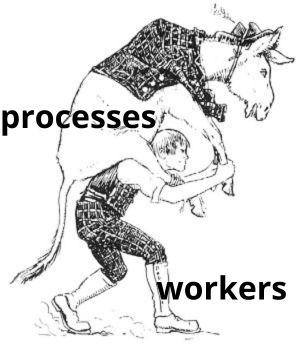
I will keep at this parabola and change the context. Now we should zoom into a more business-like setup. We will use the wisdom of the mother as established processes and Lazy Jack as the workers.
The wisdom in this sense is always right, as it is in company policies and practices. The troubling part is where we want to act based on yesterday’s learning, in a world that accelerates at an exponential scale. In another sense it is not just the temporal drift, but creating myths as well, mirroring experience and unmeasured outcomes, treated as working processes.
As we explore a topic it gets structured and hardened, as for as the abstractions create structures we traverse. So as we establish a way of working with a topic, we will have a default.
Jack is our milquetoast, corrected forever after the fact, following the mother’s wisdom into a world it no longer fits. I would to distinguish between the iron will of visionaries and this hopeful character, feeling the draft of the falling as a leading wind. Visionaries usually precede the world, in contrast with someone who is behind. The first is a strong bet, the second a misinterpretation.
But why is it so human? Because we see so many tales being around because nobody bothered to update them. Like how the go to university to land an engineering job is now completely outdated. Yet there is a peer pressure. Similarly there is a peer pressure in the form of legacy processes. We are so used to take one road we do not consider any other.
Processes often harden and loose their original meaning, this is how we get legacy processes and organizational misguidance. The world requires elasticity that mature mental structures forever fight against. It is not size and not overengineering. It is the mental toll of exploring any idea. This is why Lazy Jack is the most human character.
As being my own devil’s advocate I will cite the counter research by the University of St. Andrews where they showed that monkeys are observed to learn similarly to humans having trendsetters and group imitation learning.